
From grinding LeetCode late at night to an off-campus internship offer from Microsoft, this is the unfiltered version. The tedious applications, the referrals, the SWE coding test, and finally the offer letter.
How It Started
This was an off-campus internship, which meant I was running two tracks at once: our college’s on-campus placement drive, and a parallel off-campus hustle. It was exhausting. I was applying everywhere while also trying to use my network to land referrals at top product companies.
My biggest unlock was reaching out to seniors from my IIT, and people across other IITs, who were already placed at these companies. Cold messages, LinkedIn DMs, alumni channels, I tried all of it. Most didn’t reply, but enough did to matter. Referrals don’t guarantee anything, but they do get your resume past the first filter.
One thing worth doing: keep your LinkedIn notifications on. Product companies like Microsoft hire throughout the year, not just during campus season. That’s how I caught the Microsoft portal opening in August.
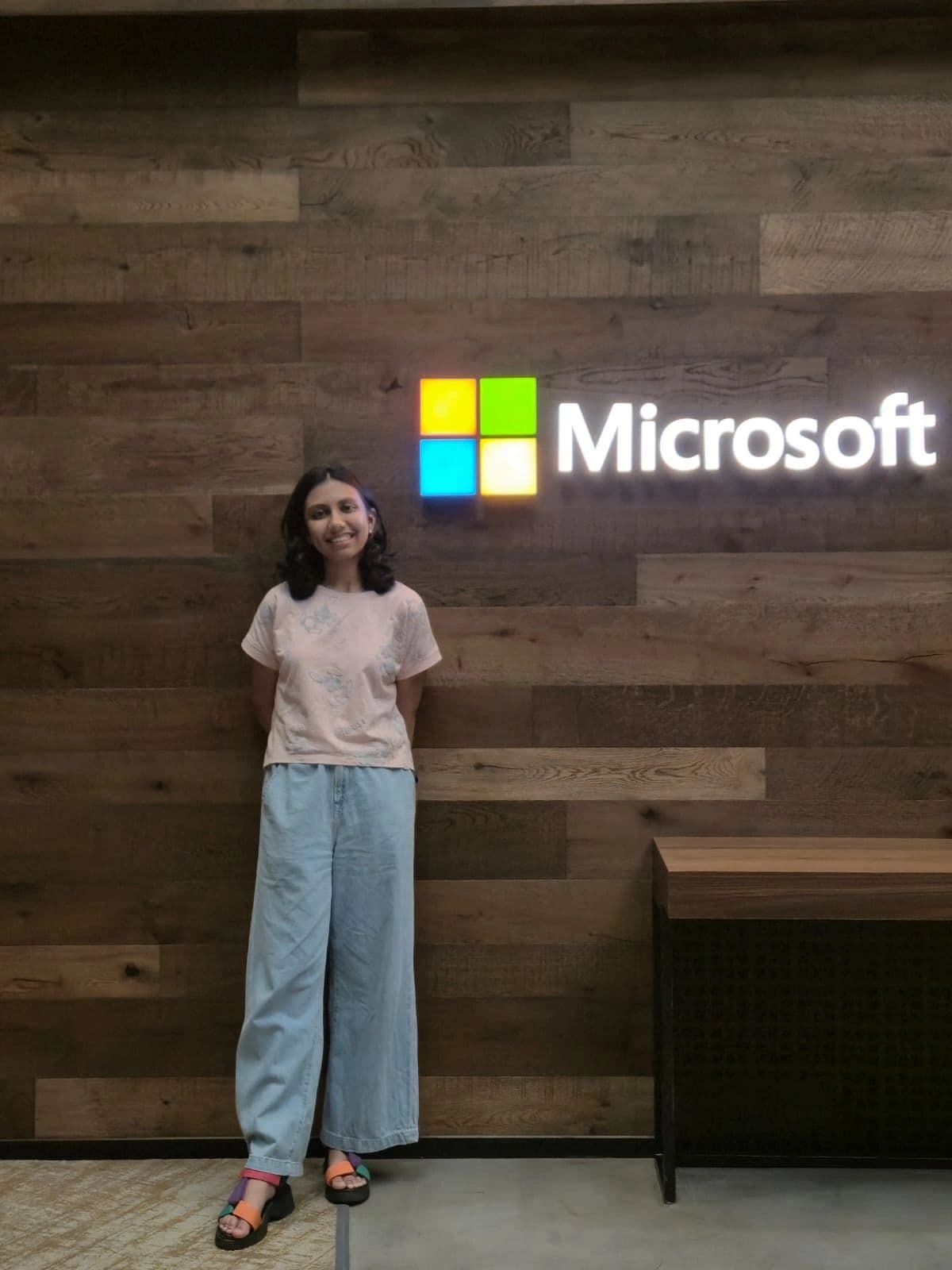
The Timeline
- August. Applied through the Microsoft careers portal as soon as the off-campus listing went live.
- September. Received the online assessment link. Two DSA problems, one on graphs and one on arrays, both LeetCode medium.
- November. Interview loop, two rounds on a single day.
- Three days later. Offer letter. A two-month internship starting in May.
Off-campus offers take time. The gap between my application and the offer was nearly three months. Keep applying elsewhere in parallel, and don’t put all your hope in one pipeline.
My Prep Strategy
Consistent DSA practice over three to four months is what moved the needle for me. I didn’t try to do everything. I followed structured courses and actually stuck with them:
- Striver’s DSA Course, excellent for building a systematic understanding of topics in the right order.
- GFG Abdul Bari Course, great for understanding algorithmic thinking from first principles.
- LeetCode, daily practice focused on mediums, especially graphs, trees, and dynamic programming.
For company-specific prep, these are the resources I used to look up Microsoft interview questions:
- LeetCode Company-Wise Problems (GitHub), a curated list of questions tagged by company, including Microsoft.
- The Job Overflow, interview experiences and questions filtered by company.
- DesiQnA, a community platform with real interview experiences from Indian students.
- GFG and LeetCode Discuss, where I read interview blogs from candidates who’d interviewed at Microsoft. Real experiences beat any prep guide.
A Detour: The Data Scientist Interview
About a week before the SWE interviews in November, I had a different Microsoft interview that doesn’t get talked about enough, for a Data Scientist role I had applied to via referral back in June.
This is where referrals proved their worth in a very concrete way: no OA, straight to interview. No coding test gatekeeping the process. The referral got me in the door directly.
The interview covered three areas:
- ML fundamentals, the core concepts you’d cover in a solid ML course. The IIT Kanpur ML course by Prof. Piyush Rai is what I reffered before the interview. It covers the theory without going too deep into research territory.
- DSA, a LeetCode-style coding question, similar to what you’d expect in an SWE round.
- HR questions, specifically “Why this role?” and a deep dive into a project from my resume. They wanted to understand what I actually built, what decisions I made, and why.
I didn’t make it to the second round. I made mistakes in the first. I rushed through some ML answers I should have slowed down on, and I didn’t explain my project as clearly as I could have. The honest lesson: a referral gets you the shot, but you still have to show up prepared for every part of the interview, not just the coding.
Even so, it was worth it. It sharpened my instincts a week before the SWE loop and taught me something I now swear by:
Apply to every role you fit. Different roles, different hiring teams, a “no” in one never touches the other.
The SWE Interview Loop
Both rounds happened on the same day. Going in, I was nervous, but two things kept me grounded: I’d read enough interview blogs to know roughly what to expect, and I’d practiced thinking out loud during mock sessions.
Round 1, purely technical. The question was on trees. I won’t lie, hearing it made me anxious for a second. But instead of going quiet, I kept talking through my approach, and the interviewer was genuinely helpful in nudging me along. That back-and-forth mattered more than landing the perfect solution instantly.
Round 2, technical plus HR. I got an easy linked list problem, which I handled comfortably. The rest was HR-style questions about motivation, teamwork, and how I handle challenges. Be honest and specific here. Vague answers don’t land.
Interviewers aren’t just evaluating your code. They’re evaluating whether they’d want to debug a production incident with you at 2am.
When I got stuck, I didn’t freeze. I talked through the brute force, found the bottleneck, and worked toward something better. That process of reasoning out loud counted for more than the final code.
The Offer
Three days after the interviews, the offer letter arrived. A two-month internship at Microsoft, joining in May. After months of applying, waiting, and second-guessing, the moment itself felt almost quiet. Like the natural result of a hundred small, unglamorous days of showing up.
If You’re Going for It
Everything I’d hand my past self on a sticky note:
- Apply the moment the role opens. Do not wait for the "perfect" time; the minute a job posting goes live, submit your application before it gets lost in the noise or buried under a mountain of candidates.
- Apply as early as possible. Off-campus hiring is incredibly slow, and it can take several months from the time you apply to actually getting a job offer. For example, I applied in August just to get an interview in December. So if you think you are applying too early, you are actually right on time.
- Chase referrals without shame. Most of your messages will vanish into the void. The few that land are worth every ignored one.
- Play more than one table. Every interview, even the one you bomb, is a lesson for the next. My failed DS round is exactly why the SWE loop felt easy.
- Be consistent, not heroic. A few quiet months of steady DSA beat a caffeine-fuelled week of panic, every single time.
- Make noise while you solve. They’re hiring a teammate, not a silent genius. Think out loud, and a half-stuck candidate who communicates wins the room.